SEO for Fashion Ecommerce: A Practical Guide for DTC Brands
Fashion ecommerce SEO is not generic ecommerce SEO with prettier photos. It requires solving four problems unique to fashion: sold-out product page authority, seasonal collection rotation, brand-vs-generic query competition, and visual discovery through Google Lens. Most agencies miss all four.
Why fashion ecommerce SEO is its own discipline

Every fashion ecommerce SEO guide hits the same checklist: alt text, mobile-friendly themes, schema markup, keyword research, trend content. That advice is correct. It’s also not what’s keeping your brand from ranking.
The actual ranking blockers are fashion-specific. Inventory turns every 60-90 days. Collections rotate seasonally. Customers search visually as often as they search textually. Return rates run 25-40% across apparel, per Shopify’s enterprise commerce data, and Google increasingly weighs post-click engagement signals. None of these problems show up on the standard ecommerce SEO checklist.
In our experience auditing DTC fashion brands, four specific issues come up on nearly every site, and three of them are invisible until you know to look.
Sold-out product pages: the URL authority problem
A best-selling product sells out in three weeks. The product page has been live for six months, has acquired internal links and external mentions, and is starting to rank for “[brand] [product name] [color]” queries. Then your store does what every Shopify theme does by default: the page either 404s or redirects to a generic out-of-stock template. All accumulated authority dies.
What to do instead, in order of preference:
- Backorder or waitlist. Keep the URL live, replace the buy button with email capture. The page keeps its rankings and converts visitors into pre-orders for the restock. Best for brands with predictable production cycles.
- 301 redirect to the closest active product. If the SKU is permanently discontinued, redirect to the same product in a different colorway or the most similar active SKU. Authority transfers, ranking transitions cleanly.
- 301 redirect to the parent collection. Last resort. Loses some specificity but preserves authority at the collection level.
Avoid 410 (Gone), avoid 404, avoid letting the URL serve a generic out-of-stock page. The first two erase the asset. The third tells Google your category churns trash, which damages domain trust over time. We covered the deeper architecture issue in our piece on fashion collection page SEO problems.
Seasonal collection rotation without losing rankings
The standard Shopify pattern is to launch a collection (/collections/spring-2025), promote it for one season, then archive it when AW25 launches. The new collection lives at /collections/autumn-2025 with zero accumulated authority while the old URL either 404s or sits dormant.
The fashion-specialist alternative is to maintain stable category URLs and use the URL as a long-term ranking asset. /collections/summer-dresses or /collections/winter-coats builds authority across multiple seasons. The seasonal collection (spring-2025, autumn-2025) becomes a sub-page or filter, not the canonical category.
When AW25 launches, the autumn-2025 sub-page inherits internal links from your blog content and homepage. The summer-dresses canonical URL keeps ranking for the evergreen query. Both compound. Neither resets to zero.
We’ve audited DTC fashion brands with five seasons of collection drops, where each season’s URL sits at zero traffic three months after launch, while the brand fights from scratch each time. The fix is structural and takes one careful migration. After that, every season compounds. More on this in our seasonal SEO playbook for fashion brands.
Brand search vs generic search: the DTC trap
DTC fashion brands almost always rank #1 for their own brand name. They almost never rank for the generic queries their actual buyers type before they know your brand exists. “[Brand] dresses” gets 200 searches a month. “Sustainable midi dresses” gets 8,000.
That’s the trap. Brand search converts at 6-12%. Generic non-brand search converts at 1-3% but drives 10x the volume. DTC brands measuring SEO by brand-search rank are measuring the wrong thing.
The reason DTC brands lose generic search isn’t keyword choice. It’s that marketplaces (Net-a-Porter, Revolve, Nordstrom) and content sites (Vogue, BoF, Refinery29) have 100x more domain authority and rank for every generic fashion query by default. The DTC playbook for beating them isn’t to outrank them on head terms. It’s to own the long-tail intent layer they don’t optimise for: “[material] [garment type] for [body type/use case/season].”
“Linen midi dress for petite frames” or “wool peacoat under $400 made in Europe.” 50-300 volume per query, 10-30 queries per cluster, all winnable for a DTC brand with category page architecture and supporting content. Get collection page SEO right and you compound across the long tail.
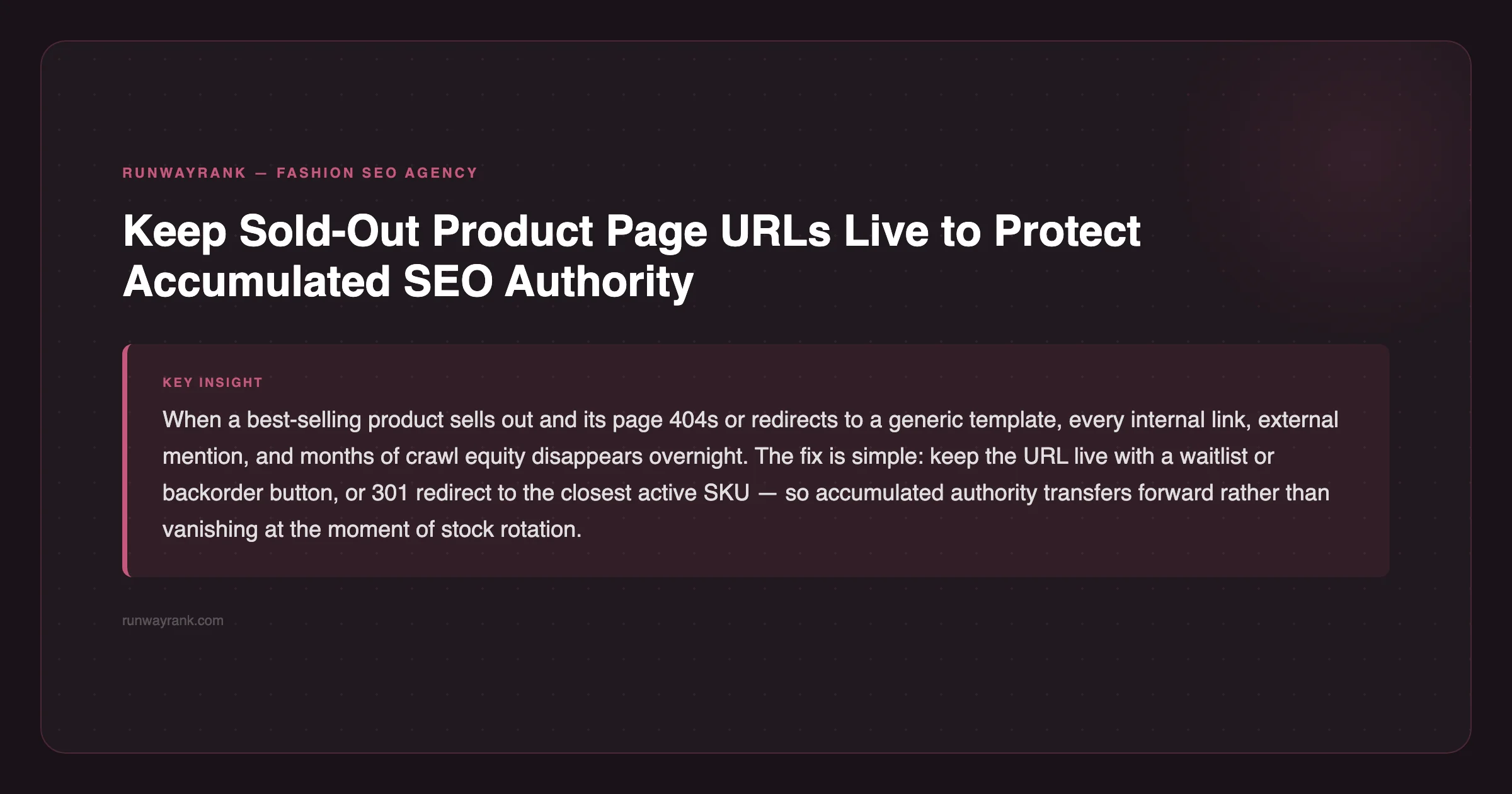
Image SEO and Google Lens for fashion discovery
Fashion is the most image-driven ecommerce category, and Google Lens has changed how customers find products. A buyer takes a photo of a friend’s jacket, Google Lens identifies similar products, the customer clicks through to whichever brand’s product image is best optimised for visual matching. If your product photography is square, well-lit, neutral background, and properly tagged, you appear. If not, you don’t.
This is a rapidly growing channel that generic ecommerce SEO guides barely mention. We covered the specifics in our Google Lens fashion SEO breakdown, but the short version: image-first ecommerce SEO is no longer optional for fashion brands. Standard advice (compress images, write alt text) is the baseline, not the strategy.
Returns and reviews: the engagement-signal problem
Fashion has the highest return rate of any ecommerce category, 25-40% for apparel versus 8-10% for electronics. Google’s Search Quality team increasingly weights post-click engagement signals, including bounce rate proxies and the share of buyers who return to search after clicking through.
Most fashion brands accept the return rate as fixed. The SEO-aware ones treat it as a ranking input. Better size guides, more honest fit descriptions, model dimensions on every product page, and structured review schema all reduce returns AND improve the engagement signals Google reads.
Google Search Central documents Review schema as a rich-result enabler, but the second-order benefit is the engagement signal cluster: buyers who read reviews before purchasing return less, which strengthens the page’s quality signal over time.
How RunwayRank approaches it
RunwayRank works exclusively with DTC fashion brands. Pricing is $750/month for established sites and $1,200/month for new domains, published on the homepage with no call required to get a number. Every engagement starts with a Shopify-specific audit covering all five issues above. The full scope is in the RunwayRank fashion SEO guide.
FAQ
What does fashion ecommerce SEO actually require? Beyond the standard ecommerce SEO checklist, fashion ecommerce requires sold-out product page handling, stable category URLs that survive seasonal rotation, and long-tail content that captures generic search away from marketplaces. Image optimisation for Google Lens and engagement-signal management through fit content and review schema complete the picture. These are platform-level decisions, not blog-post tactics.
How long does fashion ecommerce SEO take to work? Low-competition fashion long-tail queries (KD under 16) can rank within 60-90 days when category page architecture is fixed. Brand-name searches improve within 30 days. Generic head terms competing with marketplaces take 6-12 months and aren’t always the right target. Most DTC brands see meaningful traffic shifts inside 4-6 months when the technical foundation is right.
Why don’t DTC fashion brands rank against marketplaces like Revolve or Net-a-Porter? Marketplaces have 50-100x more domain authority and rank for head terms by default. DTC brands win by targeting the long-tail intent marketplaces don’t optimise for: specific materials, body types, use cases, price ranges. “Linen midi dress for petite frames” outranks the marketplace head terms because the marketplace doesn’t build pages for queries that specific.
Is image SEO actually a ranking factor for fashion? Yes, both for traditional image search and Google Lens. Fashion is the most image-driven ecommerce category, and Google Lens has become a meaningful traffic source for clothing and accessories searches. Properly tagged product photography (alt text, schema, file naming) is no longer optional for DTC fashion brands.
If your fashion site is sitting on traffic it isn’t ranking for, the gap is usually structural. See if RunwayRank is the right fit for your brand.

SEO strategist with experience in DTC brand growth, including a premium menswear brand scaled to $250K annual revenue and #1 Google rankings for B2B brands entering new markets. Built Runway Rank because every DTC fashion brand I audited had the same fixable problem: their best collection pages were invisible on Google.