Seasonal SEO for Fashion Brands: Why Timing Is Everything

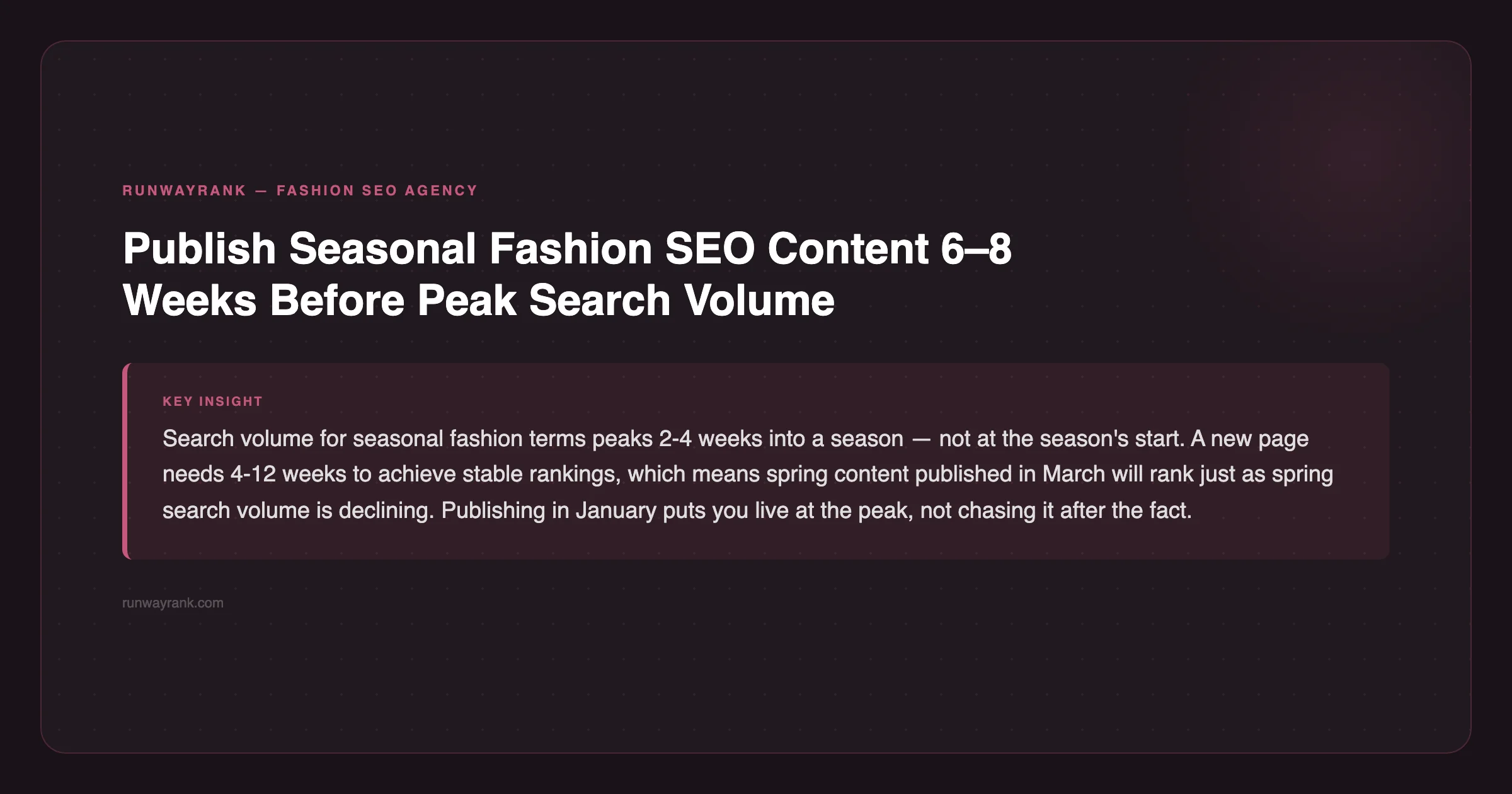
Seasonal SEO content must be live six to eight weeks before peak search volume. For fashion brands, that means publishing spring content in January, summer content in March, and holiday content in September. Most brands are running three months behind.
Fashion marketing runs on seasons. Every DTC brand knows this. But there is a consistent disconnect between how brands think about seasonal marketing and how seasonal SEO actually works.
Social media is immediate. You post a spring campaign in March and it reaches your followers that day. SEO does not work like that. A new page or blog post takes time to get crawled, indexed, and ranked. By the time Google has decided where your spring content belongs in search results, the peak search period has already passed.
The brands that win seasonal search traffic publish when it feels too early. They are not late. Everyone else is.
Why Most Fashion Brands Miss the Window

Search volume for seasonal terms does not spike on the first day of the season. It builds gradually over several weeks, peaks two to four weeks into the season, then drops. The peak is always before the moment when most brands think to publish.
Consider “summer dresses 2026”. Searches for that term start climbing in late February. They peak in April. By June, when most brands are publishing their summer content push, search volume is already declining.
What we consistently see: brands that start seasonal content in the same month as the season are always fighting yesterday’s battle. They rank for terms as searches are declining, not while they are building.
The fix is not complicated. It requires shifting your content calendar back by six to eight weeks and treating SEO content as a long-lead-time investment, like buying fabric rather than placing a last-minute order.
How Search Volume Curves Work
Search volume, the number of times a keyword is searched per month, follows predictable seasonal patterns for fashion terms. These patterns are consistent year over year with minor variation.
Google Trends shows you these curves for free. Search any seasonal fashion term and set the time range to “past 5 years”. You will see a consistent spike pattern every year.
The key insight: Google starts indexing and ranking new pages within days, but achieving stable rankings takes four to twelve weeks for most new content on young domains. If you publish eight weeks before peak, you have time to rank before volume peaks. If you publish at peak, you rank when volume is falling.
In our experience, brands that shift their content calendar by eight weeks see 40-60% more seasonal organic traffic within their first year of consistent seasonal publishing.
The Seasonal SEO Calendar for Fashion Brands
This calendar covers the main seasonal moments for DTC fashion brands targeting UK and US markets. Adjust for your specific niche and audience.
| Target Season | Content Live By | Peak Search Month |
|---|---|---|
| Valentine’s Day | December | January |
| Spring / SS Collection | January | March |
| Easter / Long Weekend | February | March |
| Summer / Resort Wear | March | May |
| Back to School | June | August |
| Autumn / AW Collection | July | September |
| Halloween | August | October |
| Black Friday / Holiday | September | November |
| Christmas Gift Guides | October | November-December |
| New Year / January Sales | November | December-January |
| Pre-Spring / Resort | December | February |
The pattern is consistent: content live two months before peak. Not one month. Not the same month. Two months.
What Seasonal Content Should You Create?
Seasonal SEO is not just about updating your homepage banner. It is about creating indexed pages that rank for seasonal search terms.
The three highest-value content formats for seasonal fashion SEO:
Collection pages with seasonal keyword targeting. If you launch a summer collection, your collection page should have a keyword-led H1 (“Women’s Summer Dresses 2026”) and be live before April. Not June.
Seasonal gift guides. Gift guides rank for high-intent searches like “fashion gifts for women 2026” and “sustainable clothing gifts Christmas”. These are blog posts that work hard every year, not one-season content.
Trend roundups tied to seasonal drops. “Best oversized coats autumn 2026” captures both trend and season. These perform well in organic and can be updated each year to stay fresh.
What we consistently see: seasonal collection pages perform the best when the keyword appears in the URL slug, the H1, the meta title, and the first paragraph. All four in one page is not over-optimisation. It is the baseline.
Planning Your Seasonal Content Calendar
Building this calendar into your workflow takes a one-time setup and then becomes automatic.
Start with Google Trends and the NRF retail calendar. Map every major retail moment to a search volume curve. Then work backwards eight weeks from each peak to set your publish deadline.
Block those publish dates in your content calendar now. If you are in April and the autumn publish window opens in July, you have three months to brief, write, and QA your autumn content.
The brands that treat seasonal SEO like a production schedule rather than an afterthought are the ones that compound traffic year over year.
Seasonal Keywords to Prioritise
Not all seasonal terms are worth targeting. Apply the same KD filter you would use for any keyword. High-volume seasonal terms (“summer dresses”) have KD 50-70 and are dominated by large retailers.
The terms worth targeting:
- Material-seasonal combinations: “linen wide-leg trousers summer” (KD 8)
- Occasion-seasonal combinations: “wedding guest dress autumn wedding” (KD 12)
- Style-seasonal combinations: “quiet luxury winter wardrobe essentials” (KD 9)
- Trend-seasonal combinations: “oversized blazer outfit ideas autumn 2026” (KD 7)
These long-tail seasonal terms have lower competition and higher conversion rates. The shopper searching “oversized blazer outfit ideas autumn 2026” is already planning a purchase. She is just looking for inspiration and product sources simultaneously.
For a deeper look at how to identify and vet these terms, read our guide on finding the right fashion keywords.
How Early Is Too Early?
Some brands worry about publishing content that feels out of season. “Will anyone click a summer article in January?”
Yes. Two reasons.
First, early-season shoppers are real. They are buying ahead. Planned shoppers spend more per purchase and return more often. They are your best customers.
Second, the page does not need to get clicks in January to justify existing. It needs to be indexed by January so it ranks by March. You are not writing for the visitor who arrives in January. You are writing for Google to index in January so the visitor who arrives in March finds you on page one.
The goal of seasonal SEO content is not to sell in the off-season. It is to rank before the on-season.
Seasonal SEO as a Compounding Asset
Here is the part most brands do not fully appreciate: seasonal SEO content compounds. A page you publish this January for spring 2026 will also rank for spring 2027 if you update the year references and refresh the content. A gift guide you write in September 2026 can be the same URL in 2027 with minor updates.
Contrast this with paid social, where every seasonal drop requires a new campaign budget. Your SEO investment from this year keeps working next year.
The fashion SEO playbook covers how to structure a full-year content strategy that treats each piece of content as a long-term asset.
If you want seasonal SEO handled as part of an ongoing programme, our seasonal SEO for fashion brands programme runs on a retainer model starting at $750/month and includes a full seasonal content calendar built at onboarding.
FAQ
When should fashion brands start publishing seasonal content?
Six to eight weeks before the peak search month. Spring content should be live in January. Holiday content should be live in September. Publishing on the day a season starts means your pages are still waiting to rank while search volume is already falling.
How far ahead should I plan seasonal SEO content?
Brief and write three months ahead, publish two months ahead. That gives you buffer for rewrites, QA, and image production without rushing to hit the publish deadline.

SEO strategist with experience in DTC brand growth, including a premium menswear brand scaled to $250K annual revenue and #1 Google rankings for B2B brands entering new markets. Built Runway Rank because every DTC fashion brand I audited had the same fixable problem: their best collection pages were invisible on Google.