Fashion SEO Keywords: How to Find the Right Search Terms for Your Brand
Fashion SEO keywords fall into four types: collection terms, trend terms, comparison terms, and visual search terms. DTC brands that target all four build search visibility faster than brands chasing only broad category terms.
Most DTC fashion brands start keyword research in the wrong place. They go straight for “women’s dresses” or “sustainable fashion” and wonder why their new site never moves. Those terms are dominated by Zara, ASOS, and Net-a-Porter. You are not competing with them on broad terms. You are competing with them on specificity.
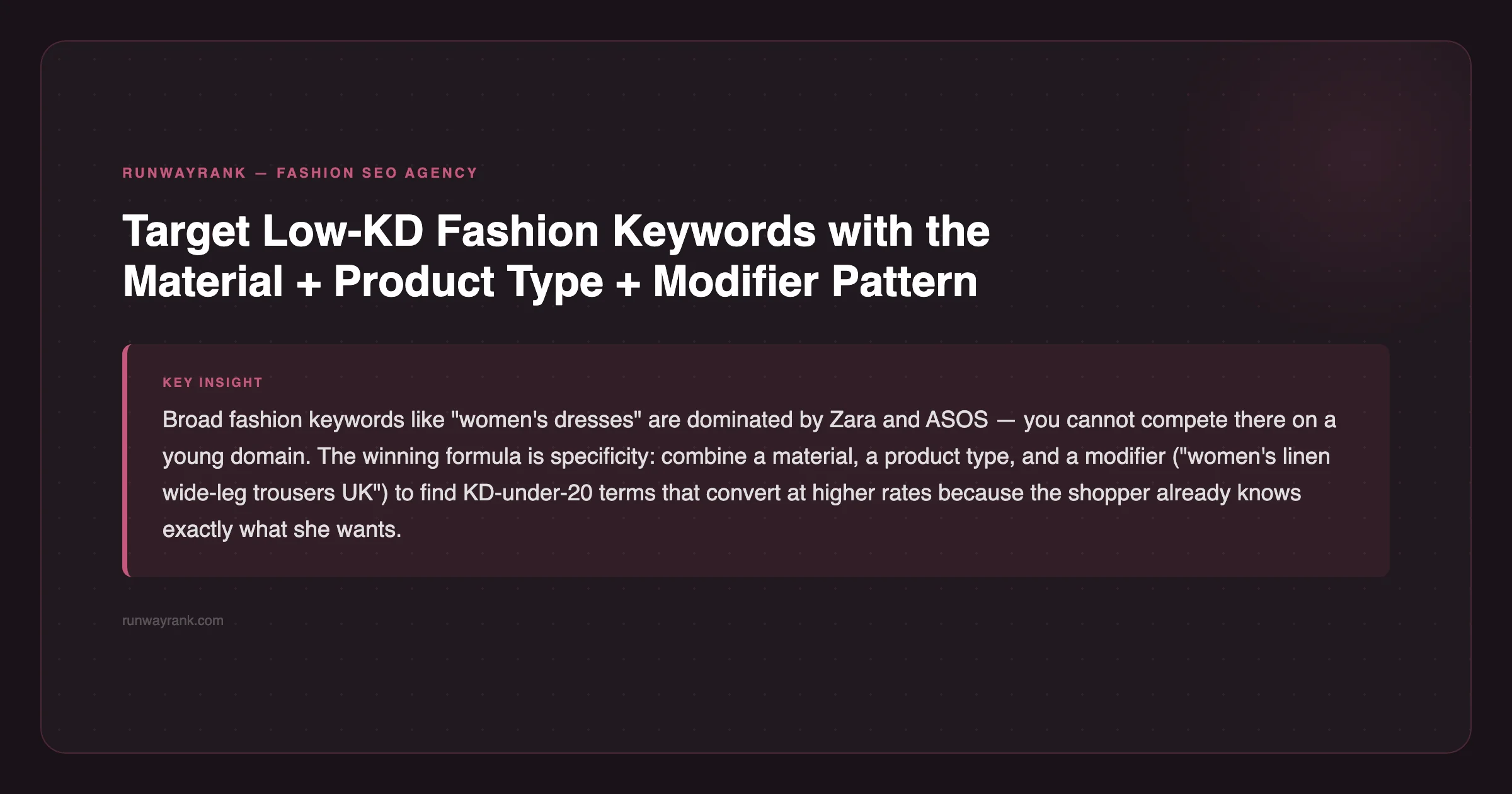
The good news: specific keywords convert better. A shopper searching “women’s linen wide-leg trousers UK” knows exactly what she wants. A shopper searching “women’s trousers” is still browsing.
This guide breaks down the four types of fashion SEO keywords worth your attention. Each one plays a different role in your traffic strategy.
What Is Keyword Difficulty and Why It Matters
Before getting into keyword types, you need to understand KD. KD, or keyword difficulty, is a score (usually 0-100) that estimates how hard it is to rank on page one of Google for a given term. The higher the number, the more authoritative sites are already ranking for it.
For a new DTC brand, anything above KD 30 is an uphill battle. You will spend months building domain authority before you see results. KD under 20 is where you can win in 6-12 weeks. KD under 10 is where you can win fast.
What we consistently see: brands obsess over high-volume terms (20,000+ searches a month) and ignore the low-volume, low-KD terms that actually convert. A keyword with 100 monthly searches and KD 8 will move your business faster than a keyword with 10,000 searches and KD 65.
Type 1: Collection Page Terms
Collection terms are the keywords that describe your product categories. These map directly to your collection pages. They are the foundation of fashion SEO.
The mistake most brands make is naming their collection pages after their internal logic, not how customers search. “The Edit” is a lovely brand name for a curated collection. Google has no idea what it means.
Real examples of collection terms with low KD:
- “women’s linen trousers” (KD 12, est. 500/month)
- “organic cotton basics women” (KD 9, est. 300/month)
- “minimalist men’s wardrobe essentials” (KD 7, est. 200/month)
- “slow fashion women’s coats” (KD 6, est. 150/month)
The pattern is: material + product type + modifier. You can build dozens of these. Each one becomes a dedicated collection page, optimised with a keyword-led H1, meta title, and opening paragraph.
In our experience, brands that rename their collection pages to match search terms see indexing improvements within four weeks. It is one of the fastest wins in fashion SEO.
Type 2: Trend Terms
Trend terms are time-sensitive keywords tied to what shoppers are actively searching right now. They follow fashion cycles, seasonal drops, and cultural moments.
These are higher-risk than collection terms because the window is short. But if you publish before the peak, you can rank while competitors are still writing their briefs.
Real examples:
- “oversized blazer 2026” (KD 11, trending Q1-Q2)
- “quiet luxury outfits women” (KD 14, sustained from 2024)
- “coastal grandmother style summer” (KD 8, seasonal)
- “tomato red fashion trend 2026” (KD 5, early trend)
Google Trends is your best free tool here. Search any trend term and look at the trajectory. Rising interest with low search volume today means a keyword you can own before it peaks.
The timing rule: trend content needs to be live at least six to eight weeks before peak search. We cover this in detail in our guide on seasonal keyword timing.
Type 3: Comparison Terms
Comparison terms are searches where a shopper is weighing options. They indicate high buying intent. The shopper is close to a decision.
Fashion comparison searches often include brand names, materials, or philosophy comparisons:
- “sustainable vs fast fashion brands” (KD 9, est. 400/month)
- “linen vs cotton summer dresses” (KD 7, est. 250/month)
- “Everlane vs Thought Clothing” (KD 4, est. 80/month)
- “organic cotton vs conventional cotton clothing” (KD 6, est. 200/month)
These work well as blog posts, not collection pages. A 1,000-word comparison article can rank for several related terms at once and bring in shoppers who are genuinely close to buying.
A word on brand vs brand comparisons: if you name a competitor in your content, keep the tone factual and helpful. Google rewards information that serves the reader. Aggressive competitor comparisons tend to read as promotional and convert poorly anyway.
Type 4: Visual Search Terms
This is the keyword type most fashion brands are not thinking about yet. Visual search, powered by Google Lens and Pinterest, is growing fast. 20 billion visual searches happen on Google Lens every month. Fashion is the top category.
Visual search queries are different from text queries. They are often more descriptive, because the searcher saw something and is trying to name it:
- “burnt orange ruched mini dress” (KD 3, rising)
- “asymmetric hem blazer women beige” (KD 5, est. 120/month)
- “woven leather bucket bag tan” (KD 4, est. 90/month)
These terms come directly from product image descriptions. Your alt text, image file names, and product page copy all feed into how Google Lens finds and categorises your products.
What we consistently see: brands with detailed, descriptive image alt text outperform brands with generic alt text like “IMG_4523.jpg” or “dress front view”. The specificity you put into your image metadata directly affects your visual search visibility. We go deeper on this in our guide to Google Lens fashion SEO.
How to Find Low-KD Fashion Keywords
The Ahrefs keyword research methodology is the most thorough approach available. But you do not need a paid tool to get started. Here is a simple process:
- Start with a seed term (“women’s linen trousers”)
- Run it through Google Trends to check demand trajectory
- Look at Google’s “People also search for” and “Related searches” sections
- Note the specific, longer-phrase variations (these are usually lower KD)
- Check which terms have dedicated pages from domain-authority brands (Vogue, ASOS). If they do, the KD is probably too high
Once you have a list of 20-30 candidate terms, organise them into the four types above. Assign collection page terms first. They build the structural foundation that makes all other content rank faster.
How Many Keywords Does a DTC Fashion Brand Need?
For a fashion store launching with SEO for the first time, start with 10-15 primary keywords. One per collection page, one per core blog post. That is enough to build initial visibility without spreading your content too thin.
Depth beats breadth at first. A collection page that fully answers one keyword query will outrank a page that partially answers five.
Our fashion SEO services starting at $750/month include a full keyword research and assignment process as part of onboarding. Every page on your site gets a dedicated primary keyword before we write a word of copy.
If you want to go deeper into the content strategy side, start with our guide to fashion SEO. It covers how keywords fit into a full site architecture.
FAQ
What are the best keywords for a fashion brand?
The best keywords are low-KD (under 20), specific, and match real purchase intent. Collection terms like “women’s linen trousers” and visual search terms like “asymmetric hem blazer beige” outperform broad terms for new and growing DTC brands.
How do I find low-competition fashion keywords?
Start with Google’s “People also search for” and “Related searches” to find specific variations of your seed terms. These long-tail phrases typically have lower KD and higher conversion rates. Google Trends helps you validate demand before you invest in content.

SEO strategist with experience in DTC brand growth, including a premium menswear brand scaled to $250K annual revenue and #1 Google rankings for B2B brands entering new markets. Built Runway Rank because every DTC fashion brand I audited had the same fixable problem: their best collection pages were invisible on Google.