What to Look for in a Fashion SEO Agency (And 3 Red Flags to Avoid)

A good fashion SEO agency demonstrates platform-specific technical knowledge, publishes its pricing, shows results from fashion clients, understands seasonal search behavior, and reports on metrics that connect to revenue. Finding one that does all five takes more than a Google search.
Why This Hire Matters More Than It Used to

SEO for fashion brands has become meaningfully more complex in the last few years. Visual search (Google Lens) now pulls product images directly into search results. AI-generated answers are claiming space above organic results for some fashion queries. And the filtering and navigation architecture of fashion e-commerce platforms creates technical SEO problems that generalist agencies routinely miss.
A generalist agency that has not worked on catalog-heavy e-commerce stores will miss most of this. The technical layer alone, the crawl budget issues created by faceted navigation on collection pages, is invisible to anyone without direct fashion e-commerce experience.
This guide is for DTC fashion founders who want to hire well. Not cheaply, not quickly. Well.
5 Things to Look For
1. Demonstrated Fashion E-Commerce Expertise
Fashion e-commerce platforms have their own SEO constraints and opportunities. Canonical tag handling on filtered collection pages, the way platforms structure URL parameters, and how CDN configurations interact with Core Web Vitals (the set of page speed and stability metrics Google uses as a ranking signal) are all platform-specific issues.
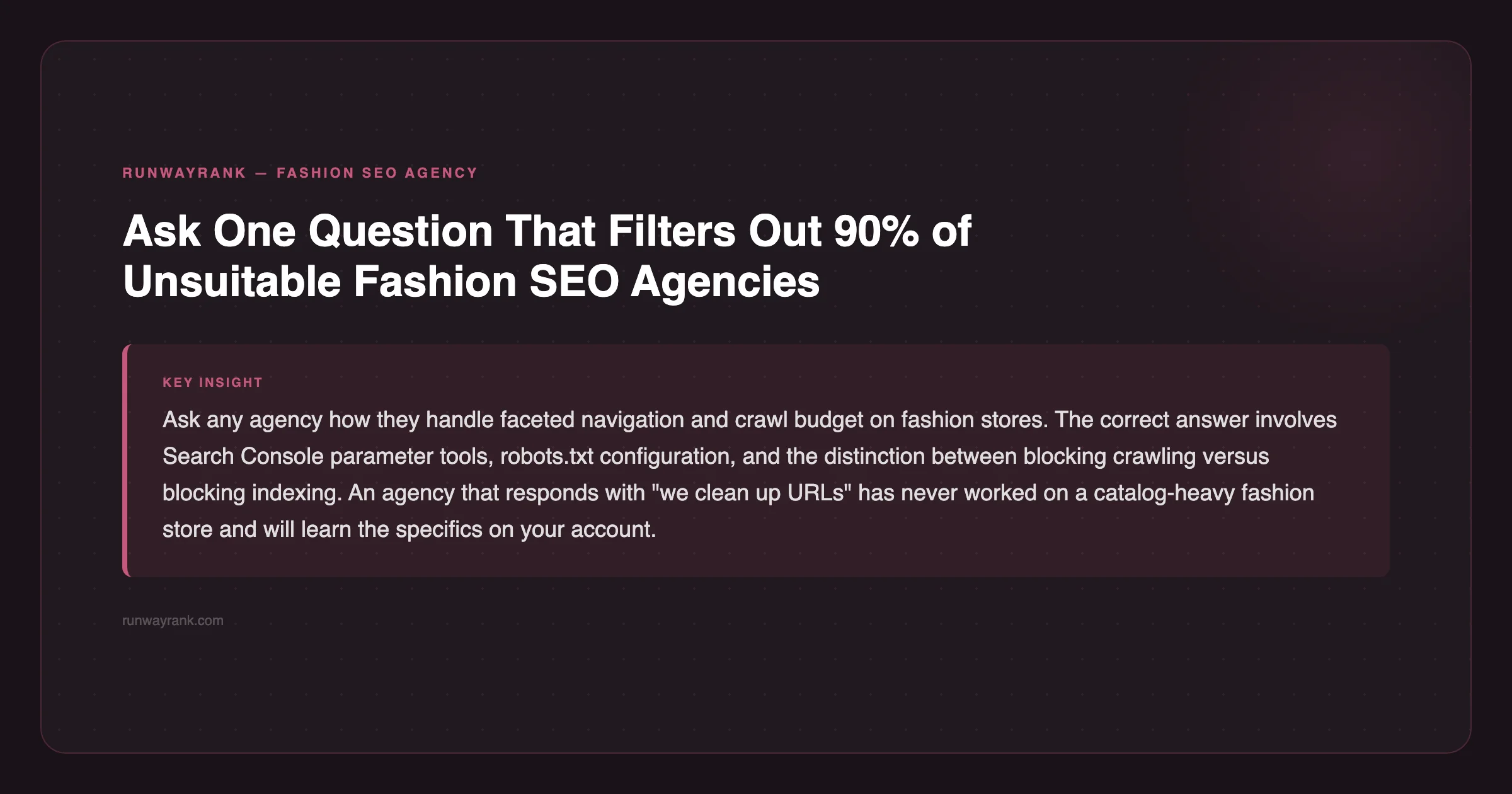
Ask any agency you are evaluating to walk you through how they handle faceted navigation on fashion stores and what they do about it. If they give you a vague answer about “cleaning up URLs,” dig further. The correct answer involves crawl budget management, robots.txt configuration, and Search Console parameter tools. If they cannot explain the specifics, they do not have fashion e-commerce depth.
This question alone will filter out the majority of agencies that should not be on your shortlist.
2. Published Pricing
An agency that does not publish its pricing is not being strategic. It is withholding information you need to make a fair comparison. Fashion SEO services exist on a wide spectrum of price and quality. Knowing the price range upfront lets you evaluate whether the scope matches the cost.
Published pricing also signals an agency’s confidence in its offer. If a shop is clear about what it charges and what that covers, that clarity usually carries into the work itself.
3. Fashion-Specific Case Studies or Client Examples
Generic case study: “We grew organic traffic 200% for an e-commerce client.” Fashion-specific case study: “We restructured collection page architecture for a DTC womenswear brand, reduced crawl waste by 60%, and increased collection page rankings from page 4 to page 1 within 5 months.”
The difference is detail. Fashion has enough distinct characteristics (seasonal drops, product variants by color and size, visual search as a traffic source, collection pages as the primary ranking asset) that an agency without fashion e-commerce experience will handle it the same way they handle every other client.
Ask for examples from brands in adjacent categories if they do not have direct fashion clients. Apparel, footwear, accessories, and beauty all share the catalog complexity that separates fashion SEO from standard e-commerce SEO.
4. Seasonal Content Capability
Fashion SEO is not evergreen in the way that B2B or software SEO is. Seasonal drops create predictable peaks in search volume. An agency that cannot plan and publish content 6-8 weeks ahead of those peaks will consistently miss the window.
Ask how they approach seasonal planning. Do they use tools like Google Trends to identify search volume curves? Do they publish collection page updates before each major season or only when you ask? Do they treat the content calendar as a strategic asset or a reactive task list?
The Search Engine Journal covers how seasonality affects e-commerce SEO planning in several published guides, which gives you independent benchmarks to compare against any agency’s answer.
5. Transparent Reporting Tied to Revenue Metrics
An agency should report on organic traffic, keyword rankings, and crawl health. But it should also connect those metrics to something that matters to your business: sessions to collection pages, organic revenue attribution, conversion rate from organic traffic.
Ask to see a sample report. If it shows keyword rankings without any connection to traffic or revenue, that is a scope problem. Rankings are a leading indicator. Revenue is the outcome. A good report tracks the path between the two.
3 Red Flags to Avoid
Red Flag 1: No Fashion E-Commerce Knowledge
This is the clearest disqualifier. Fashion e-commerce platforms are not just generic CMS systems. Their architecture affects how collection pages are crawled, how product variants are handled, how filters generate URLs, and how canonicalization works across paginated pages.
An agency that describes their process in purely generic terms (site audit, keyword research, link building, content) without referencing fashion e-commerce mechanics has not worked on fashion stores at any meaningful depth. This is especially true given the catalog complexity of fashion, which amplifies every platform-specific limitation.
In our experience working with fashion brands, the clients who hire generalist agencies often come to us after a year of flat results and a series of deliverables that were technically correct but wrong for their platform.
Red Flag 2: Hidden Pricing With a “Custom Quote” Default
Some custom pricing is legitimate. Large enterprise accounts genuinely need scoped quotes. But a fashion SEO agency that cannot give you a ballpark for standard monthly retainer work is either pricing opportunistically or has not productized its service well enough to know what it delivers.
Both are problems. Ask directly: “What does a standard monthly retainer look like in terms of price and scope?” If the answer is a redirect to a sales call with no approximate figure, move on.
Red Flag 3: Generic Keyword Spreadsheets as the Primary Deliverable
What we consistently see on fashion stores from brands who have already worked with SEO agencies is a folder of keyword research that was never connected to their collection pages. The agency exported a spreadsheet of 300 keywords with volume and difficulty scores, left it with the client, and called it a strategy.
Keyword research is an input, not a deliverable. The deliverable is a mapping of those keywords to specific collection pages, with clear instructions on how to implement the changes. An agency that does not map keywords to pages and tell you exactly what to change has done the easy part and left the hard part to you.
Questions to Ask Before Signing
Ask these five questions in your first substantive conversation with any agency:
- How do you handle faceted navigation and crawl budget on fashion stores?
- Can you show me a report from a current or past fashion client?
- How do you plan seasonal content, and how far in advance?
- What does your monthly retainer cover, and what costs extra?
- How do you connect keyword rankings to revenue in your reporting?
The answers will tell you everything you need to know. Technical fluency, transparency, strategic thinking, and accountability all surface quickly when the questions are specific.
How Runway Rank Approaches This
For context on what a fashion-specific SEO agency actually delivers, we built Runway Rank entirely around DTC fashion brands. No generalist clients, no mixed-industry case studies.
A good agency checks crawl budget first, before touching content or keywords, because the technical layer determines how fast everything else compounds. If you want to understand the full picture before making a hire, start with our fashion SEO fundamentals guide.
FAQ
How much should fashion SEO cost per month?
For a focused monthly retainer covering technical monitoring, collection page optimization, and content, expect a range of $750-$1,500 per month for established fashion stores. New domains with more ground to cover typically sit higher in that range. Be skeptical of pricing below $500 per month for anything beyond basic maintenance, and of agencies that will not tell you their rates at all.
What questions should I ask an SEO agency before hiring?
Ask how they handle faceted navigation on fashion stores, whether they can show you a fashion client example, how they plan seasonal content, and how they connect keyword rankings to revenue in their reports. Specific technical questions separate agencies that have done this work from those who will learn on your account.
How do I know if an agency understands fashion specifically?
Ask them to name two SEO problems that are specific to fashion e-commerce. The right answer covers faceted navigation and crawl budget, plus either visual search optimization or seasonal content timing. If they describe generic e-commerce problems, they do not have fashion-specific depth.

SEO strategist with experience in DTC brand growth, including a premium menswear brand scaled to $250K annual revenue and #1 Google rankings for B2B brands entering new markets. Built Runway Rank because every DTC fashion brand I audited had the same fixable problem: their best collection pages were invisible on Google.